Thursday, August 4, 2011

Lady Maryland: Trip #4 (Day Eight)

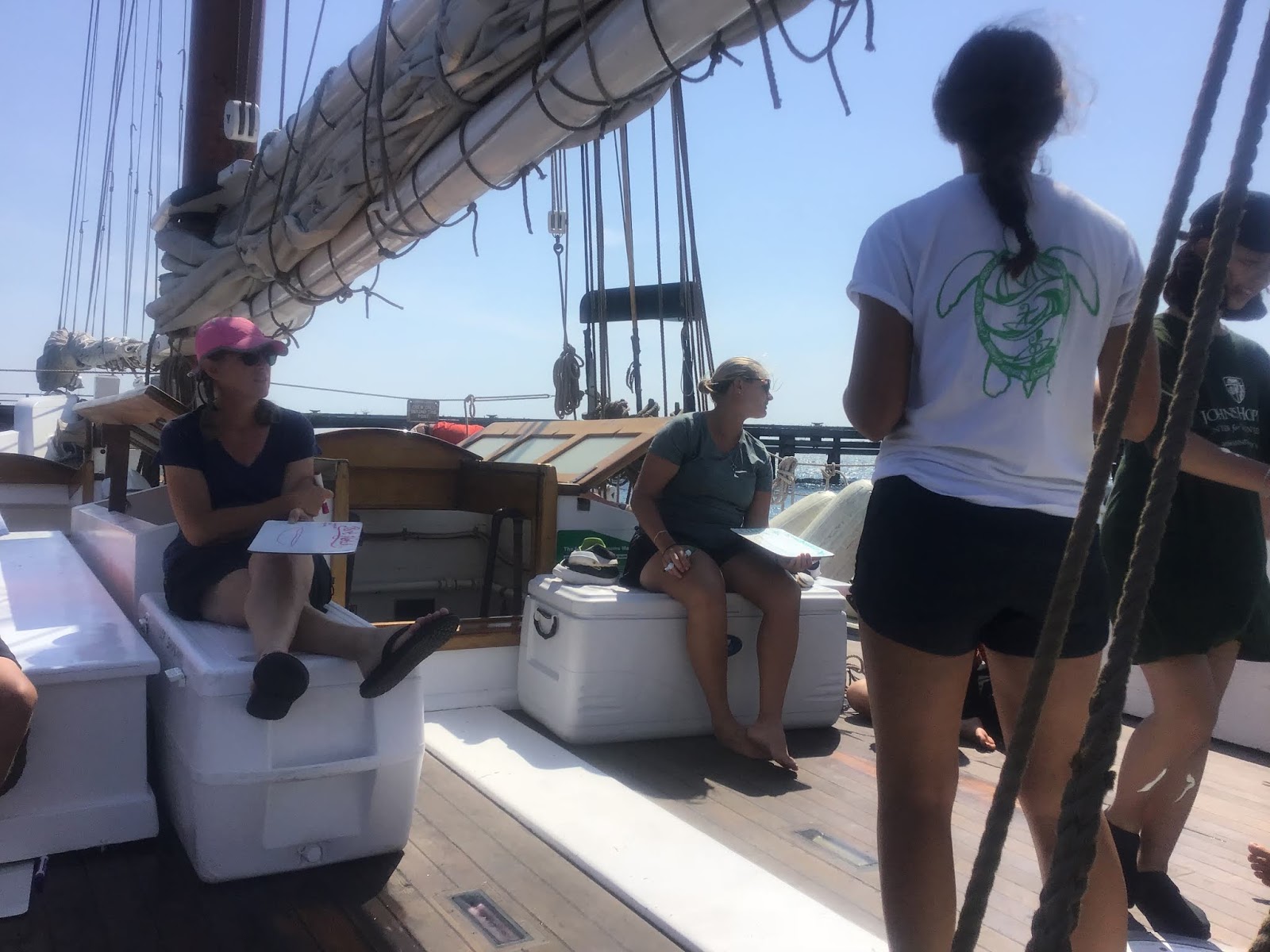
Hard to believe, but it's already our last full day on the Lady Maryland! Today was a busy day as we tried to clean up the ship, squeeze in some last minute lessons, and, finally, end our adventure with some fun and games.

Before anything else, we started the day off with a swim call before breakfast. Almost everyone jumped in for one final swim, and despite the hour (7:00am), it was a fun and refreshing way to start the day.

After we hauled back anchor near Warwick, RI, we were headed, at long last, back to Bristol. We started off the day by throwing a plankton net into the water and collecting different samples of plankton to look at under our magnifying camera. We learned about the importance of plankton despite its small size -- for example, nearly 70% of the oxygen we breath comes from plankton -- and got a little more practice in identifying different creatures.

After playing with the plankton and returning them to the water, the cadets threw the trawl net one more time. This time, we hauled up a few blue crabs, which have a brilliant hue of blue on their legs and pinchers.

Finally, it was time for what the crew referred to as "Field Day", what we soon learned meant cleaning - a lot. We spent the afternoon scrubbing the lovely Lady Maryland from bulkhead to bow and left her in sparkling condition for the next group.

The second, and more exciting, half of Field Day was the Schooner Olympics, during which the two watches, Port and Starboard, faced off in various challenges, including identifying the different lines, knot tying, on-watch skills, recalling the ship's Standing Orders, and, as the grand finale, setting the jib in "storm conditions". This meant that the crew, standing in as stormy weather (since in reality it was another nice night), used buckets of water to simulate big waves at the bow and hoses to simulate torrential rain. The cadets did a great job, the Port watch team even singing sea shanties as they set the sail, and everyone had a lot of fun.

After changing into dry clothes and eating a great last dinner on the deck, each watch presented their final project. The Port watch group created a "whale of the past," the predecessor of the narwhal called a "narwhog", which had a tusk resembling that of the modern-day narwhal but lived both on land and in the water. The Starboard watch group created a "whale of the future", the descendant of a sperm whale called a "deviljho", which had various adaptations making it more suited for a far-distant future, where the ocean is more acidic and the whale hunting technology is much improved. Both groups did a great job.

We finished the night with a game of Whales and Estuaries jeopardy on the deck, and then, with a view of the Bristol harbor and skyline, we all settled into bed, ready to wake up for one final anchor watch. What an awesome trip it's been!

The cadets haul back the anchor as we leave Warwick, RI and head back towards Bristol.

The group catches plankton in a plankton net to study under the microscopes.

Studying different types of plankton under the camera -- here, a "megalops" (on the screen).

Ready to throw the trawl one last time!

The Starboard watch team tying various knots during the Schooner Olympics.

Captain Michael explains the last event in the Schooner Olympics -- setting the jib in "storm conditions"...

Starboard watch team sets the jib!

Port watch team sets the jib...

and still sings sea shanties, despite the terrible conditions!

Wednesday, August 3, 2011

Lady Maryland: Trip #4 (Day Seven)

Today has been fairly leisurely, as we were at sea most of the day, sailing through Narragansett Bay, finally headed back towards Rhode Island. The cadets split the day between being on watch and working on their final projects, which involves creating whales of the past and future based on what they know about whales of the present and the various adaptations of whales.

During the educational portion of the day, the cadets learned more about estuaries - how they were formed and why they are so important as mating and nursing grounds for so many different animals. They also returned to their lesson about water health, examining the results of their experiment from a few days ago. They found the calcium carbonate of the egg and crab shell entirely intact in both the fresh and salt water, and very much dissolved in the vinegar, to the point where the egg had almost no shell at all and the crab shell was flexible and bendy, almost like plastic. Though vinegar is an extreme example to represent the pH levels in our oceans, the levels are changing each year, and the cadets were reminded that if these shells could dissolve in strong acid in just a few days, they could definitely be effected by weaker levels of acid throughout their lifetime. Additionally, plankton has much thinner calcium carbonate shells than the full grown crab shells we used for our experiment, and should plankton stop being able to survive, it would effect the food chain all the way to the top.

The cadets, feeling a little somber after this lesson, were cheered up by the fact that we had accidentally anchored right in the middle of a cat boat race track. Though this meant we couldn't go swimming, we spent the night watching small boats race around us in Greenwich Bay, and were promised an early swim call in the morning.

Tomorrow, we head towards Bristol!

Tuesday, August 2, 2011

Lady Maryland: Trip #4 (Day Six)

"It was cool to see the ways things were long ago in Mystic, in the old timey days." - Sarah

Today we woke up early and sailed into Mystic Seaport on the Mystic River in Connecticut. The seaport is home to one of largest maritime museums in our country, with its shoreline set up as it would have been in the mid-1800s, back when Mystic was an important seafaring village full of big trade boats and skilled craftsmen.

Unbeknownst to us, we were sailing in on a very important day for Mystic – the birthday of Herman Melville, who wrote the American classic Moby Dick. Therefore, there were multiple celebrations going on around Mystic, including a 24-hour reading of Moby Dick which we were lucky enough to walk into during the climactic last chapter.

The cadets spent the day exploring the museum, one of the highlights of which included the Charles W. Morgan, the last wooden whaling ship in the world. The ship is under renovation, but visitors are still allowed to walk inside for a closer look at how and where the crew would have worked and lived. The cadets are now familiar with different parts of a ship, but this was definitely the more massive and impressive version we’ve seen so far. We learned a lot about the process of whaling and the dangers that sailors used to face as they attempted to find and kill whales. Even after the hunt was over, the whalers would have to drag the whale back to the ship using a small boat, often rowing for hours due to the weight of the whale, and then start the long process of cutting off the blubber, hoisting it onto the ship, and cooking it down into oil, often in a race against the sharks that would circle the whale and eat away at its blubber. We all agreed that we’d pass on a position as a whaler were it offered to us.

The rest of the museum was made up of other ships, various exhibits (a favorite being the exhibit on the history of tattoos), and old buildings set up as 19th century businesses, including a bank, a publishing house, a grocery, a chemist, a ship supply shop, a blacksmith, and many others. A scavenger hunt encouraged the cadets to interact with the different staff members who were posing as craftsmen, and they learned a lot about how a seafaring village would have been run. We also joined a small audience to watch an interactive play called “Tale of a Whaler”, during which we learned more about life on a whaling ship (and reaffirmed our conviction that we wouldn’t want to be a “greenhand”, or an inexperienced sailor, on a whaling ship).

In the afternoon, we were treated to a lesson in sea shanties, or songs sung on deck to help in the hoisting of sails, the heaving in of anchors, and other jobs that involved rhythmic work. We were told that a shanty has been said to be equivalent to ten extra men on the line. Music was a big part of life for sailors, and the sea shanties had influences from all over the world due to the diversity of the whaling ship crews. There was also often a designated “shanty man” who would be responsible for leading the shanties. After our lesson, we went back inside the Morgan to witness a “dog-watch”, which is a two-hour shift on deck during which the men were allowed to socialize and, often, play music. Here, we heard more songs of the sea, this time mostly ballads, played on multiple instruments that the crew would have had on the ship, including a pair of “rhythm bones” made from real bone.

After a long day, we headed back to the Lady Maryland and settled in for a night at the dock. Thunder storms were rolling in all around us, but somehow avoided the area where we were docked, so that we had a great view of the storm without getting wet. Before bed, the crew had a surprise for us. Below deck, we got to watch a movie called Around Cape Horn about a man named Irving Johnson who sailed around Cape Horn aboard a shipping vessel in 1929 – and filmed it. The storms the crew encountered near the Cape were incredibly violent and dangerous, and the footage, some of it shot from the highest rigging, was extraordinary. Though we all went to sleep feeling a little less intense about our own adventures, I think it’s safe to say we all feel a little smitten with the sea.

Tomorrow morning, we head back towards Bristol!

Preparing to dock at Mystic.

Cadets ready to ease our docking with a few roving fenders.

A demonstration on the different positions of the crew during a whaling kill.

A small model of the Charles W. Morgan, the last remaining wooden whaling ship in the world.

(Almost) the whole gang of the Lady Maryland at Mystic Seaport!

Watching the storm settle over Mystic River.

Monday, August 1, 2011

Lady Maryland: Trip #4 (Day Five)

"My favorite part about visiting Block Island was getting to feed the dead squid to the spider crabs after we dissected them." - Harry

Another awesome day on the Lady Maryland! It's hard to believe that our voyage is halfway over already!

This morning we set sail early and headed towards Block Island, an island off of the Rhode Island coast that attracts a lot of visitors for its bicycling, hiking, fishing, and of course, its beautiful beaches. We started the day off by exploring more of the local marine life, this time using a tool called a "dredge" that sinks into the muddy ocean floor and catches sea life as it drags along the bottom. The cadets all helped to haul the dredge up, but they got a little timid when they realized that what the dredge had primarily caught was a whole lot of mud. Nonetheless, some jumped in to feel their way through the mud, and we eventually sorted out a few shell fish. Not entirely satisfied, we decided to throw the trawl again, too. This time, we hauled up a whole spectrum of creatures: small fish, starfish, jelly fish, crabs, shell fish, and more. The cadets spent the next hour identifying and studying our different species before we released them back into the water.

The group was feeling much more energized and alert today after a good sleep on a calm sea under the stars, and as we sailed towards Block Island, the group kept in high spirits by singing songs, new and old, as they stood watch and cleaned the ship. The cadets also learned about water health, and tested the varying levels of phosphate, dissolved oxygen, and salinity in samples drawn from the side of the ship. They determined that the water was fairly healthy, but talked about the overall health of water on our planet and how it is being affected by humans. We will take more tests tonight on anchor watch to see if the water where we anchor, near land, is any different from the water further out at sea.

Captain Michael had warned us that the Block Island harbor would be worse than the mall parking lot on Christmas Eve, and sure enough, when we sailed into the salt pond in the center of Block Island that serves as the harbor, there were boats everywhere: huge yachts, fellow schooners, fancy sailboats, small speedboats – even an old, rusty military tug boat! It was fun to look around at all the ways to travel over the water, and to compare our dear schooner’s various parts to other boats as we passed. Finally, we found a good place to drop the anchor, and a small transporting boat picked us up to take us ashore.

We were dropped off at BIMI, the Block Island Marine Institute, where we spent the next hour observing the marine life that BIMI had collected in observation tanks. In one tank, where scallops cohabited with starfish, the cadets attempted to place scallops near enough to starfish to witness the starfish catch and eat the scallops, as they had learned that starfish eat by vomiting digestive fluids into their prey. Though there were some close calls, the scallops always won out, snapping their shells and scurrying away at the last moment. Needless to say, it was very interesting to watch, and the cadets were amazed at the diversity of life in our waters.

After spending some time at the observation tanks, our cadets got the opportunity to dissect squids! Each cadet got his or her own, and they were taught how to cut a squid apart into its various organs, learning each organ’s purpose as they went. A few cadets were brave enough to eat the lens of the squid eye – supposedly full of vitamins – and most ended up with more than a little squid ink on his or her fingers. Afterward, they got to feed the squid pieces to the spider crabs in the observation tanks. Opinions were mixed about whether the lesson was gross or awesome, but overall it was very interesting. Afterward, the cadets were ready to head back to the ship and haul out towards the Fishers Island Sound, where we would anchor for the night.

The cadets continue to have a great time, and each day they become more comfortable with the different components of sailing, taking initiative and often handling the sails almost completely on their own. Tomorrow, we’ll sail a short distance to Mystic, Connecticut – our sixth state in as many days! The crew is very excited for Mystic, a port that they had to skip on the previous trip, so we're excited, too, though we're not sure what we'll find there. Another day, another adventure!

Cleaning out the trawl net after fishing.

Studying the animals we caught in the trawl.

Observing the marine life at the Block Island Marine Institute.

Squid, pre-dissection...

and mid-dissection.

Captain Michael lays the charts out to show us where we've been and where we're headed.

Sunday, July 31, 2011

Lady Maryland: Trip #4 (Day Four)

“Everything about the day was good, but my favorite thing was anchor watch because I did all of the bearings and checked everything by myself.” - Scott

Today has been a day full of sunshine and a whole lot of learning as we continue to travel down the coast!

This morning we woke up to a calm sea and beautiful skies as we sailed away from Provincetown towards Sakonnet River in Rhode Island. Last night we each stood watch for an hour to ensure that the dock lines didn’t tighten too much or the fenders get pushed out of place as the tide shifted, as that could result in broken lines or a banged up ship. Despite some drizzle through the night, everything went well, and everyone was happy to wake up once again to clear skies. We’ve been extremely lucky with weather so far!

After breakfast, we split up, the Port team cleaning the galley and main salon while the Starboard team kept watch on deck. This was a very important job, as we spent the morning navigating through the Cape Cod Canal, where there was a lot of traffic and only a narrow waterway compared to what we have been sailing. The cadets did a great job working together and communicating about other ships as we made our way through and enjoyed the beautiful scenery of the canal, including some awesome mansions along the water.

Once through the channel into Buzzards Bay, the crew had a surprise for us – trawl fishing! This is a type of fishing that involves dragging a large, weighted net behind the boat for a period of time in order to trap fish and other sea life. After working together to lower the net into the water (and smelling the net for good luck!), we talked about the dangers of trawl fishing and the detrimental effects it has when used as a means of catching large amounts of fish and sea life in commercial fishing. Luckily, the Lady Maryland has a license to use a small trawl in these waters for research purposes as long as we record what we find and throw it all back unharmed. When we raised the net, we had caught multiple crabs, mollusks, and shellfish. The cadets spent some time identifying the different species using field guides before carefully returning them to their natural habitat.

After helping to man the ship for awhile, it was back to learning – this time discussing the pH levels of the water and the changing nature of the oceans due to Co2 pollution. The cadets designed their own experiment to test how varying pH levels affect crab shells, immersing shells in fresh water, salt water, and vinegar, the vinegar representing what could happen to creatures with calcium carbonate based shells should the ocean continue to be polluted. We’ll check back on the experiment in a few days!

Once anchored in Sakonnet River – which the cadets were excited to find out shares some views with Roger Williams, though we couldn’t see the campus – Captain Michael asked if anyone wanted to go for a little swim. Positive responses were unanimous, and so we spent the rest of the evening jumping off the ship into the water (and washing up, finally, with biodegradable dish soap!), eating a great dinner on the deck, learning about constellations in the perfectly clear night sky, telling ghost stories, and finally, watching a fireworks show that just happened to be directly in front of the ship (we responded with blasts of the ship’s horn and lots of clapping!). It couldn’t have been a better night, and we all settled into our sleeping bags on deck under the stars, agreeing that it had been one of the best days we’d had so far. We'll wake up again for anchor watch, and tomorrow morning, we'll head to Block Island for more surprises and adventures!

Cadets work together to "sweat" the line, the last and hardest step in raising the jib sail, to ensure that the sail is taut.

Learning about trawl fishing in Buzzards Bay.

Getting ready to drop the trawl!

The cadets study what we pulled up in the trawl - here is a pregnant Spider Crab!

Creating an experiment to test the affect of different pH levels on marine life.

Swimming in the Sakonnet River!

A beautiful night - excited for tomorrow!

*Please note: Some pictures have been added to previous posts, so make sure to check them out!

Friday, July 29, 2011

Lady Maryland: Trip #4 (Life on Deck)

Matt plots a course on the charts.

The boys clean the dishes after a meal.

Sarah keeps lookout for other ships and potential dangers from the bow.

Scott steers at the helm.

The cadets scrub the floors, or "soles", of the ship as part of a twice-daily maintenance procedure.

Lady Maryland: Trip #4 (Day Three)

"It was so interesting seeing the whales up close after learning so much about them!" - Whitney

Today was filled from morning until night with what we all came to see -- whales!

We started the morning headed south towards Cape Cod, and since the crew was tired from sailing through the night, the cadets took charge of the deck: steering, serving as lookouts, and checking the ship. The waves from yesterday had calmed a little but now we were headed straight into the wind. The captain explained that we have to sail regardless of the wind direction, so with the wind at our bow we had to zigzag back and forth through the night, making the trip much longer than it would have been had the wind been behind us or to the side. Nonetheless, the cadets kept on with smiles, and we spent the morning manning the ship and reviewing what we've learned so far about whales.

As it so happened, we were crossing over a bank that attracts a lot of whales due to the shallower water levels, and just as we had hoped, we spotted whales just off our course to Provincetown. The cadets identified the whales as humpbacks, the largest population of whales in this area, and though they didn't get too close to the ship, it was still very exciting to see them breach and fluke in the distance, especially because for many of us this was our first encounter with whales!

A few hours later, we arrived in Provincetown and everyone worked together to pull the Lady Maryland up to the dock and get tied up. The first thing we noticed at the dock was another large sailboat, which the crew explained is a replica of a typical Dutch sailboat used in the 1600s. The cadets, with their newly acquired knowledge of sailing, analyzed the shape of the boat and the strange square sails. After we disembarked, the crew of the other ship offered to give us a tour, and we all noted the differences between that ship and ours and gained a better understanding of how sailboats have evolved over the years. We all appreciated our small bunks much more after we were told that the crew used to have to sleep on the deck with all of the lines!

In Provincetown (or "PTown", as they call it here), we poked around shops and enjoyed some well-deserved ice cream before heading for the final activity of the day – whale watching on a professional boat with the first whale watching company in the world! Though the weather was gray and overcast, we were assured that the whales would make-up for the dreary skies – apparently they like to play in the waves as much as we do! After a long ride around the Cape, we sure enough found ourselves right in the heart of what seemed to be a whale playground. Humpback whales were blowing through their blow-holes, breaching, slapping their flukes on the water, and just generally swimming around on all sides of our boat. At one point a particularly playful whale came right up to our boat, breached close enough to spray us all on the deck, and then swam under the boat, only to pop up and continue the show on the other side! Needless to say, it was a truly awesome experience, and we found ourselves running from side to side on the deck for over an hour as we watched the whales in their natural waters.

Back at the Lady Maryland (which after only a few days is beginning to feel like home), a few of the cadets wrote some reflective haikus about the day:

Bustling with life;/PTown on a cloudy day./I want seafood. -- Harry

Black flukes in the air/Come crashing down with a splash./Very majestic. -- Harry

Whale did breach, did breach/Whale breach splash splashed me, yes splashed/Now I am wet: darn. -- Max

Gray and overcast./Perfect day for watching whales/All around the Cape. -- Anonymous

Humpback whales at play./Sails full of wind and sunshine./Lady Maryland. -- Anonymous

Another awesome day!